Calm Review: 2026 Overview
The verdict
4.3/ 5 A calming meditation, sleep and relaxation app known for Sleep Stories and a soothing interface.
Calm is the one to beat for sleep and pure relaxation, with a library and an interface that are hard to top. For broader personal development — reflecting, building habits, following a guided plan — it does less than an all-in-one app like Liven.
Calm is a meditation app built around sleep and relaxation, and this Calm review covers what it does well and where it stops short. Made by Calm.com, Inc., it leans on guided meditations, a deep music library, and its famous Sleep Stories. If your main goal is winding down, it is one of the easiest apps to love.
As a personal development app, Calm is more of a calming companion than a structured self-improvement system. It earns a 4.3 out of 5 in our editorial scoring for doing one thing beautifully, while leaving heavier journaling and habit work to other tools.
What is Calm?
Calm is a meditation and sleep app from Calm.com, Inc. that helps you relax, ease everyday stress, and fall asleep more easily. It is self-guided, so you pick a session and press play rather than following a coach. You can use it on iOS, Android, and the web, which makes it simple to start a meditation on your phone and finish a longer soundscape on a laptop.
The app draws on three familiar methods: mindfulness, relaxation, and sleep. In practice that means breathing exercises, body-scan meditations, ambient music, and narrated stories designed to quiet a busy mind. Calm does not try to be an everything app. It picks a calming lane and stays in it, which is a big part of why it feels so polished.
Who is Calm best for?
Calm is best for people who struggle to fall asleep and want a gentle, reliable way to drift off. Its Sleep Stories and music library are the headline reason most people download it, and they hold up to that reputation. If bedtime is your hardest part of the day, this is a natural first pick.
It also suits anyone who wants relaxation and stress relief without a steep learning curve, plus people who simply care about how an app feels. If you want the most soothing design in the category and a calm place to land after a long day, Calm fits. It is a weaker match if you are looking for deep journaling, habit tracking, or a structured plan for working on yourself.
What it's like to use Calm
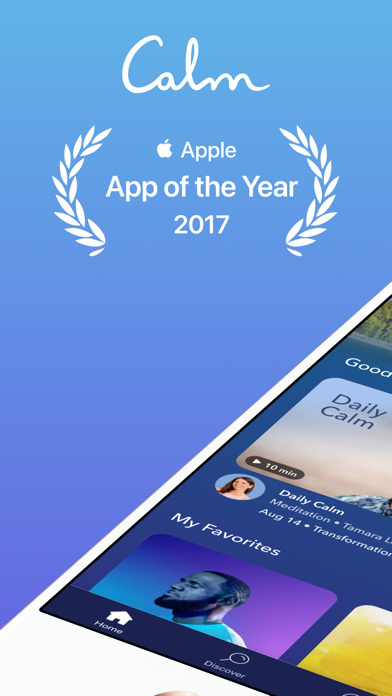
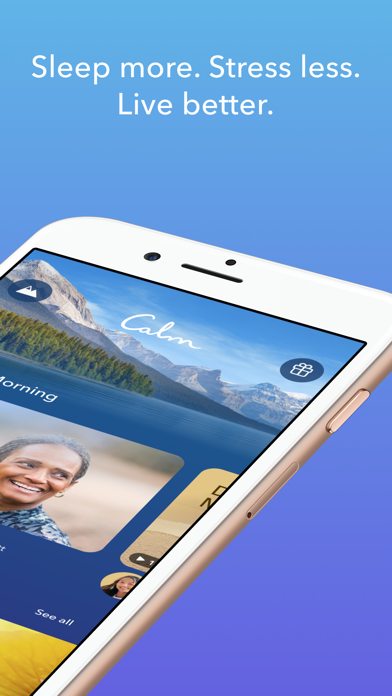
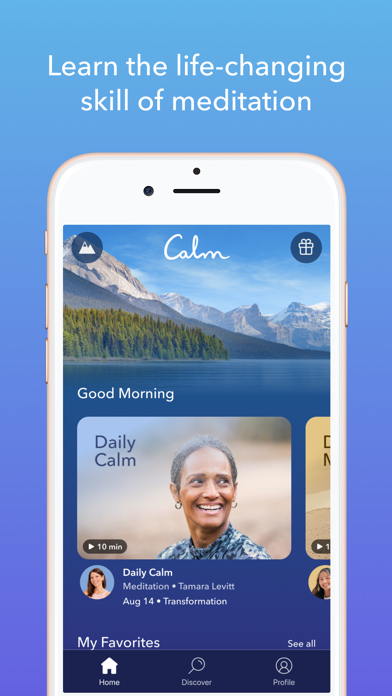
Opening Calm feels like stepping into a quiet room. The interface is unhurried, the colors are soft, and the soundscapes start almost immediately, so there is very little friction between wanting to relax and actually relaxing. A daily mood check-in gives you a small, low-effort moment of reflection without asking much of you.
Day to day, the rhythm is light. You might run a short breathing exercise in the morning, glance at a reminder later, and queue a Sleep Story at night. Apple Health sync and home-screen widgets make those moments easier to reach, and offline access means a saved session still works on a plane or in a dead zone. There is gentle structure here, but it stays optional, which is exactly what a relaxation-first app should do.
Calm's features in depth
The standout features are Sleep Stories narrated by familiar voices and a deep music and soundscape library. These are the parts people talk about, and they are genuinely well produced. Alongside them you get a broad set of gentle, soothing meditations, some courses for learning the basics of mindfulness, and a daily mood check-in that doubles as light journaling.
Calm rounds this out with practical touches: reminders to keep a routine, crisis resources for harder moments, Apple Health sync, widgets, and offline downloads. It is worth being clear about what is not here, because it shapes who the app is for. Calm has only that light daily check-in rather than full journaling, and it does not include a habit or routine builder, quizzes, a community, an AI companion, or live coaching. None of that is a flaw on its own; it is simply a relaxation tool rather than a complete self-development system.
Treat Calm as a support for everyday wellbeing and better sleep habits, not as a replacement for professional care. It can help you build a calmer evening routine and a little more self-awareness, but it is a tool, not therapy.
Calm pricing and value
Calm offers a free tier so you can sample the experience before paying, and most of the library opens up with a subscription. For exact numbers, see the pricing section on this page, since we keep prices out of the prose so they stay accurate over time.
On value, the picture is mixed but fair. If you use it nightly for sleep and relaxation, a subscription can earn its keep, and the production quality is high. The honest catch is that premium adds up, and the occasional lifetime price is steep enough to give pause. Because the app is relaxation-first, you are paying mainly for sleep and meditation content rather than the wider journaling, habit, and self-discovery tools you would expect from a broader personal development app.
What users say about Calm
Calm is very highly rated on the app stores, and the themes in reviews are consistent. People often praise the Sleep Stories and music library, and a recurring note is how calming and well designed the whole app feels. For many users it has simply become part of the bedtime routine.
The criticisms tend to cluster around value and depth. Some reviewers feel that too much sits behind the subscription, and a few mention that the price, especially lifetime, feels high. Others who came hoping for more structured self-improvement notice that journaling and habit tools are light. As always, treat these as general patterns rather than a verdict on your own experience.
Calm vs Liven: how they compare
The simplest way to frame Calm versus Liven is by time of day. Calm is built for winding down: sleep, relaxation, and the most soothing experience in the category. Liven is built for actively working on yourself across the day, with a guided plan, mood tracking, deeper journaling, courses, and an AI companion. They are aiming at different moments, not fighting over the same one.
Where Calm clearly wins is the evening. Its Sleep Stories, soundscapes, and gentle design are hard to beat when your goal is to relax and fall asleep. If that is your priority, Calm is an excellent choice and Liven does not try to out-soothe it on that front.
Where Liven is broader is everything around personal growth. It brings the journaling, habit-building, structured plan, and self-discovery that Calm intentionally leaves out, so it works as an all-in-one personal development app rather than a single-purpose one. Honestly, many people could use both: Calm at night to wind down, and Liven during the day to keep building the habits and self-awareness they are working on. You can compare them more closely on our liven-vs-calm page.
Maker: Calm.com, Inc. · Platforms: iOS, Android, Web · Approach: Self-guided · Methods: mindfulness, relaxation, sleep
Calm plans & pricing
Free tier: Some free content; most is paid.
Trial: Free trial commonly offered on the annual plan.
Prices approximate, as of June 2026 — verify on the App Store / Google Play. The bulk of meditations, Sleep Stories and music require Calm Premium.
Cancellation: Cancel through your app-store subscription. As with most annual plans, set a reminder before renewal.
Feature checklist
- Mood trackingYes
- JournalingDaily check-in
- AI companion—
- Courses & lessonsYes
- MeditationsYes
- Soundscapes / focus musicYes
- Habit & routine builder—
- RemindersYes
- Quiz / assessment—
- Community—
- Live coaching—
- Crisis resourcesYes
- Data export—
- Apple Health / Google FitYes
- Home-screen widgetsYes
- Offline useYes
Calm pros & cons
What's good
- Arguably the most soothing interface in the category
- Famous Sleep Stories and a deep music/soundscape library
- Very high store ratings
What to weigh up
- Like Headspace, it's relaxation-first — light on journaling, habits and structured self-discovery
- Premium pricing adds up, and the lifetime price is steep
Support
Support runs through Calm's help centre. There's no live clinician in the app.
Method & credibility
Calm positions itself for general wellbeing and relaxation rather than treatment, and centres mindfulness and sleep science.
Privacy & data
Check Calm's privacy policy for how check-in and usage data are handled; standard wellbeing disclaimers apply.
Third-party ratings
- 4.8 / 5 on App Store — as of June 2026, verify
- 4.4 / 5 on Google Play — as of June 2026, verify
We report independent ratings with their source and date and never invent them. Figures here are approximate and pending verification before launch.
Our data: Calm
Two proprietary indices we score ourselves, on the same scale for every app (see all 20 on the compare page):
Calm FAQ
Is Calm good for sleep?
Yes. Sleep is Calm's strongest area. Its Sleep Stories narrated by familiar voices and its deep music and soundscape library are the main reasons people download it, and they are well produced. If falling asleep more easily is your goal, it is one of the easiest apps to recommend.
Does Calm have journaling and habit tracking?
Only lightly. Calm includes a daily mood check-in that acts as light journaling, but it does not offer full journaling, a habit or routine builder, quizzes, a community, an AI companion, or live coaching. If those matter to you, a broader personal development app like Liven will fit better.
Is Calm worth the subscription?
It can be if you use it regularly for sleep and relaxation, since the content quality is high and there is a free tier to try first. The honest trade-off is that premium adds up and the occasional lifetime price is steep, so check the pricing section and weigh how often you will actually use it.