
Headspace Review: 2026 Overview
The verdict
4.4/ 5 A polished, friendly meditation and mindfulness app with structured courses and sleep content.
Headspace is the most polished mindfulness app here and a brilliant on-ramp to meditation, especially for sleep. It's narrower than an all-in-one self-discovery app, though — if you also want journaling, courses and a daily companion in the same place, Liven covers more ground.
This Headspace review covers a self-guided meditation app from Headspace Inc. that teaches mindfulness through structured courses, guided sessions, and a deep sleep library. The bottom line: it is one of the most polished, beginner-friendly personal development apps for learning to meditate and building a calmer bedtime routine, though it stays narrower than an all-in-one wellbeing tool.
If you want a gentle, well-produced on-ramp to meditation rather than a sprawling toolkit, Headspace is an easy app to recommend. Our editorial score lands at 4.4 out of 5.
What is Headspace?
Headspace is a meditation and mindfulness app made by Headspace Inc. It walks you through guided meditation and mindfulness techniques in short, narrated sessions, with structured courses that build skills step by step. The consumer app is self-guided, so you move through the content at your own pace rather than meeting with a coach inside it.
It is worth being precise about scope, since Headspace operates in a wider health space than the app alone. Its clinical care services are sold to employers and health plans, not bundled into the consumer subscription you download from an app store. The app you get as an individual is a self-guided personal development app for everyday wellbeing, not a substitute for professional care.
Headspace runs on iOS, Android, and the web, so your progress follows you across phone, tablet, and browser. The core methods are mindfulness and guided meditation, presented with the kind of calm, considered design the brand is known for.
Who is Headspace best for?
Headspace is best for beginners to meditation who want structure. If you have tried to sit quietly and felt unsure what to actually do, the guided courses give you a clear path instead of an empty timer. The hand-holding is a genuine strength here, not a gimmick.
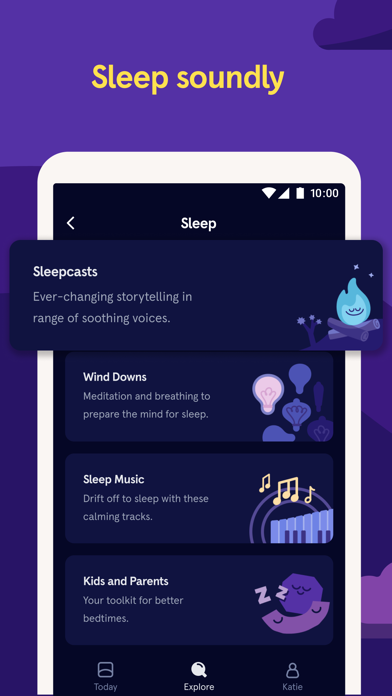
It is also a strong pick if better sleep is your main goal. The sleep library is large and varied, with content designed to help you wind down and settle a busy mind at bedtime. People who care about polish and a calm, uncluttered design will feel at home too.
It is a weaker fit if you want one app to do everything. If your wishlist includes a full journaling workspace, a habit or routine builder, quizzes, a community, or live coaching, Headspace will feel narrow, because it deliberately focuses on the meditation and sleep lane rather than trying to cover all of personal development at once.
What it's like to use Headspace
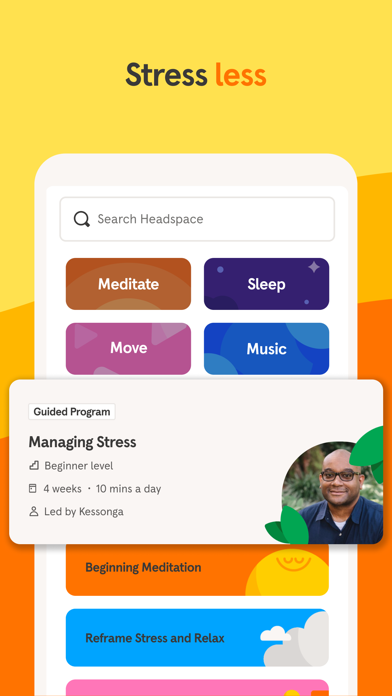
Opening Headspace feels calm rather than busy. The visual style is soft and friendly, sessions are easy to start, and the app rarely overwhelms you with options. For a beginner, that restraint matters, because it lowers the small frictions that often end a new meditation habit before it starts.
Day to day, you tend to pick a course, a single guided meditation, or something from the sleep library, then let the narration do the work. Mood tracking lets you note how you are feeling, reminders nudge you to come back, and focus and soundscape music are there when you want background sound for work or rest. Widgets and offline playback make it simple to fit a session into a commute or a quiet moment without signal.
Behind the calm surface there is sensible practicality. Headspace syncs with Apple Health, surfaces crisis resources for moments when someone needs more than an app, and in some markets includes an AI feature called Ebb. The overall experience is consistent and well-produced, which is a big part of why people stick with it.
Headspace's features in depth
The heart of Headspace is its course structure and guided meditations. Courses are well-produced and sequenced so each session builds on the last, which is exactly what most newcomers need to turn a vague intention into a routine. Individual guided meditations cover specific moments and moods when you do not want a full course.
The sleep content is a standout. A large sleep library gives you a real menu of ways to wind down at night, and many people end up valuing Headspace as much for bedtime as for daytime mindfulness. Focus and soundscape music round this out for work sessions or background calm.
Supporting features are thoughtful without trying to be everything. You get mood tracking, reminders, Apple Health sync, home-screen widgets, offline access, and built-in crisis resources, plus the Ebb AI feature in some markets. What you will not find is a journaling workspace, a habit or routine builder, quizzes or assessments, a community, or live coaching inside the app. That is a deliberate trade-off: Headspace does fewer things and does them with real polish.
Headspace pricing and value
Headspace uses a subscription model, with the bulk of its courses, guided meditations, and sleep content gated behind a premium plan. There is usually a way to sample the app before you commit, but the full library is the paid experience. For exact current prices and any trial, see the pricing section on this page rather than relying on figures here.
On value, your view will depend on how much you use it. If you meditate regularly and lean on the sleep library most nights, the subscription earns its keep, because the production quality and structure are hard to match. If you only dip in occasionally, premium can feel pricey for what is, at its core, a beautifully made audio library. Heavy users tend to feel they get their money's worth; light users sometimes do not.
What users say about Headspace
Reviewers consistently praise how approachable Headspace is for beginners. A recurring theme is that the guided structure finally made meditation click for people who had bounced off other apps, and the calm design earns a lot of goodwill. It sits among the highest-rated apps in the category on the app stores, which see the ratings section for specifics.
The most common complaint mirrors our own read: people who expected an all-in-one wellbeing app can find it narrower than they hoped, with limited journaling or habit tools. Some long-term users also question whether the subscription stays worth it once they have worked through the courses they wanted. As themes go, these are about scope and price rather than quality, and few reviewers fault the craft of the content itself.
Headspace vs Liven: how they compare
Headspace and Liven solve related problems from different angles. Liven is an all-in-one personal development app: it combines mood tracking, journaling, structured courses, habit building, an AI companion called Livie, and soundscapes in one place. Headspace is more focused, concentrating on meditation and sleep rather than spanning the whole of self-improvement.
Where Headspace genuinely wins is polish within its lane and reputation. Its meditation and sleep content is exceptionally well-produced, the design is calm and beginner-friendly, and it carries some of the highest store ratings in the category. If meditation and a better sleep routine are your main goals, that depth and finish are real advantages.
Where Liven pulls ahead is breadth. If you want journaling, habits, and guided courses working together alongside an AI companion, Liven covers ground Headspace deliberately leaves out, which is why it is our top overall pick. Many people are well served by Headspace; the honest question is whether you want a focused meditation app or a broader toolkit, and you can dig into the trade-offs on our Liven vs Headspace comparison.
Maker: Headspace Inc. · Platforms: iOS, Android, Web · Approach: Self-guided (separate clinical care offered to organisations) · Methods: mindfulness, guided meditation
Headspace plans & pricing
Free tier: Limited free content; most courses are paid.
Trial: Free trial commonly offered on the annual plan.
Prices approximate, as of June 2026 — verify on the App Store / Google Play. Most courses, the full sleep library and the structured programs require a subscription.
Cancellation: Cancel through your app-store subscription; the annual plan is straightforward to manage.
Feature checklist
- Mood trackingYes
- Journaling—
- AI companionEbb (in some markets)
- Courses & lessonsYes
- MeditationsYes
- Soundscapes / focus musicYes
- Habit & routine builder—
- RemindersYes
- Quiz / assessment—
- Community—
- Live coaching—
- Crisis resourcesYes
- Data export—
- Apple Health / Google FitYes
- Home-screen widgetsYes
- Offline useYes
Headspace pros & cons
What's good
- Beautifully designed and genuinely beginner-friendly
- Strong, well-produced course structure and sleep content
- Among the highest store ratings in the category
What to weigh up
- Narrower than an all-in-one app — it's mindfulness-first, with limited journaling or habit tools
- Premium can feel pricey for what is mostly audio content
Support
Support is handled through Headspace's help centre. There's no live clinician in the consumer app.
Method & credibility
Headspace has invested in research over the years and is upfront that its app is for general wellbeing rather than treatment. Frameworks centre on mindfulness.
Privacy & data
Review Headspace's privacy policy for how mood and usage data are handled; it ships standard wellbeing disclaimers.
Third-party ratings
- 4.8 / 5 on App Store — as of June 2026, verify
- 4.4 / 5 on Google Play — as of June 2026, verify
We report independent ratings with their source and date and never invent them. Figures here are approximate and pending verification before launch.
Our data: Headspace
Two proprietary indices we score ourselves, on the same scale for every app (see all 20 on the compare page):
Headspace FAQ
Is Headspace good for beginners?
Yes. Headspace is one of the most beginner-friendly meditation apps available. Its structured courses guide you step by step instead of leaving you alone with a timer, which makes it easy to start a habit even if you have never meditated before.
Does Headspace have journaling or habit-building tools?
No. Headspace focuses on guided meditation and sleep, so it does not include a journaling workspace, a habit or routine builder, quizzes, a community, or live coaching in the consumer app. If you want those in one place, a broader app like Liven will fit better.
Is Headspace worth the subscription?
It depends on how much you use it. If you meditate regularly or rely on the large sleep library most nights, the polished, well-produced content tends to justify the cost. If you only open it occasionally, premium can feel pricey for what is mostly audio. See the pricing section for current details.